
Apollo 11
Apollo 11 carried Neil Armstrong, Buzz Aldrin and Michael Collins on the first mission to land people on the Moon and return them safely to Earth.
The mission in three questions
- Could the complete crewed landing, ascent, rendezvous and Earth-return architecture work?
- What were mare basalt and regolith like when examined in laboratories on Earth?
- Could surface instruments continue useful measurements after the astronauts departed?
Mission purpose and context
Apollo 11 combined three distinct spacecraft roles: a command and service module for Earth return and lunar-orbit operations, a lunar module for descent and ascent, and a Saturn V launch vehicle that supplied the energy needed to leave Earth. Its purpose was to land two astronauts, perform useful surface work and return the crew safely.
Spacecraft and mission architecture
Michael Collins remained in the command module Columbia while Neil Armstrong and Buzz Aldrin descended in the lunar module Eagle. The lunar module was purpose-built for vacuum operations and used separate descent and ascent stages. The architecture avoided landing the heavy Earth-return spacecraft on the Moon.
Payload and measurement highlights
- The Early Apollo Scientific Experiment Package included a passive seismometer and laser-ranging retroreflector.
- The crew collected about 21.6 kg of rocks and regolith for laboratory analysis.
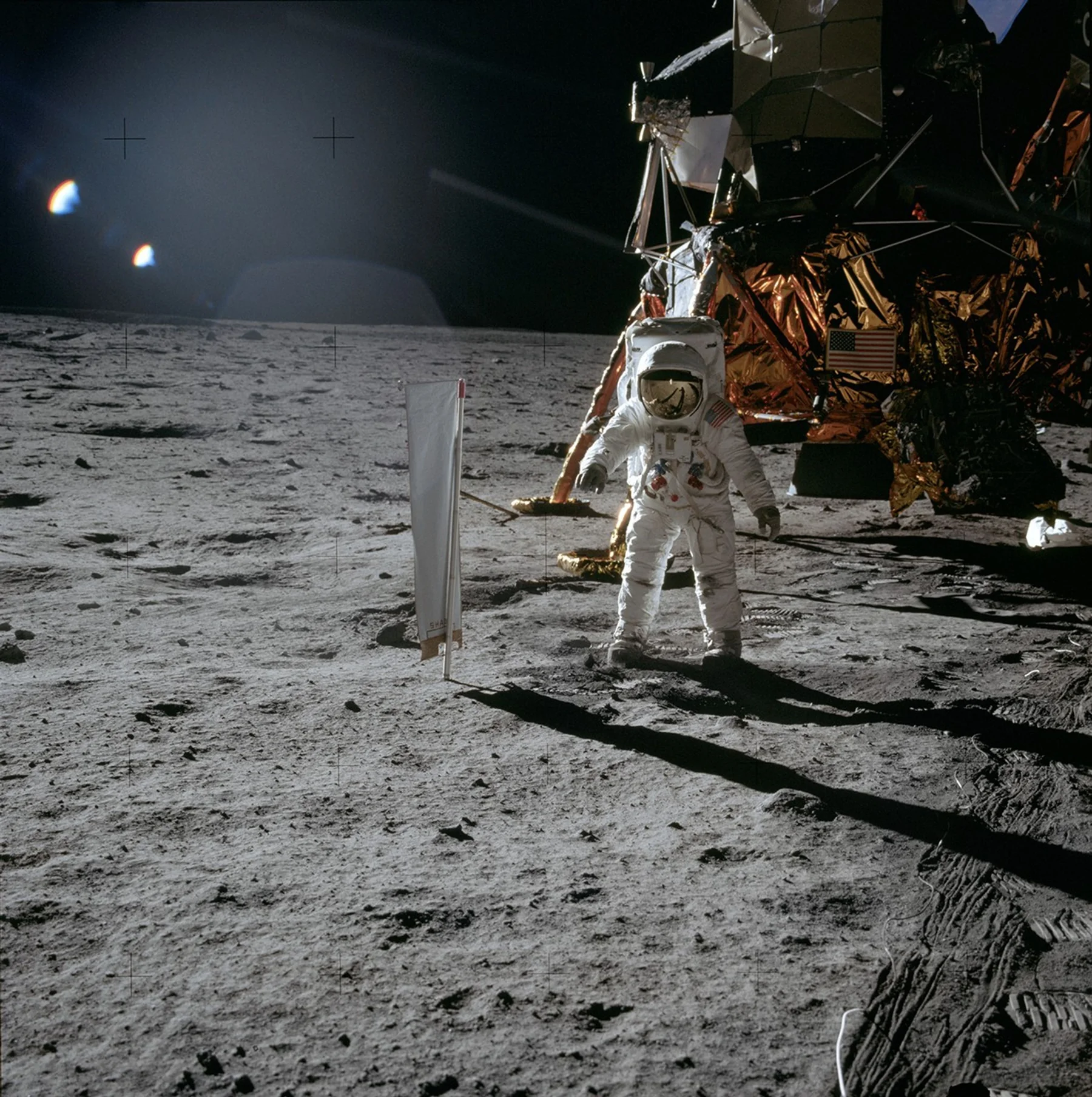
- Photographic documentation recorded the landing site, sampling context, equipment and local terrain.
Flight and surface operations
Apollo 11 launched on 16 July 1969, entered lunar orbit, and landed in Mare Tranquillitatis on 20 July. Armstrong and Aldrin spent about 21.5 hours on the lunar surface and conducted a single EVA lasting roughly 2.5 hours outside the lunar module. Eagle's ascent stage later rendezvoused with Columbia for the return to Earth.
Mission sequence
- 16 July 1969: Saturn V launched Columbia and Eagle from Kennedy Space Center.
- 20 July: Eagle landed in Mare Tranquillitatis while Columbia remained in lunar orbit.
- Armstrong and Aldrin completed one surface EVA, collected samples and deployed experiments before Eagle's ascent stage rendezvoused with Columbia.
- 24 July: the command module returned the crew to Earth by Pacific Ocean splashdown.
Science and measurements
The crew collected about 21.6 kg of lunar material, photographed the site and deployed experiments including a passive seismic experiment and a laser-ranging retroreflector. The samples established direct laboratory access to lunar basalt and regolith and became a foundation for modern lunar chronology and geochemistry.
What changed because of this mission
Apollo 11 proved the complete chain of crewed lunar operations: navigation, orbit insertion, descent, landing, EVA, ascent, rendezvous, trans-Earth injection and atmospheric return. Later Apollo missions devoted more time to field geology, but Apollo 11 established that the architecture worked.
Mission outcome
Armstrong and Aldrin explored Mare Tranquillitatis, deployed experiments and collected lunar samples while Collins remained in lunar orbit.
The outcome should be read against the mission's actual objectives and architecture. Multi-element missions can have different results for an orbiter, lander, rover or sample-return stage, while a shortened mission can still return important science or demonstrate a critical technology.
Continue through the ecosystem
Primary reference
NASA - Apollo 11. Apollo 11 mission facts and history.