
GRAIL
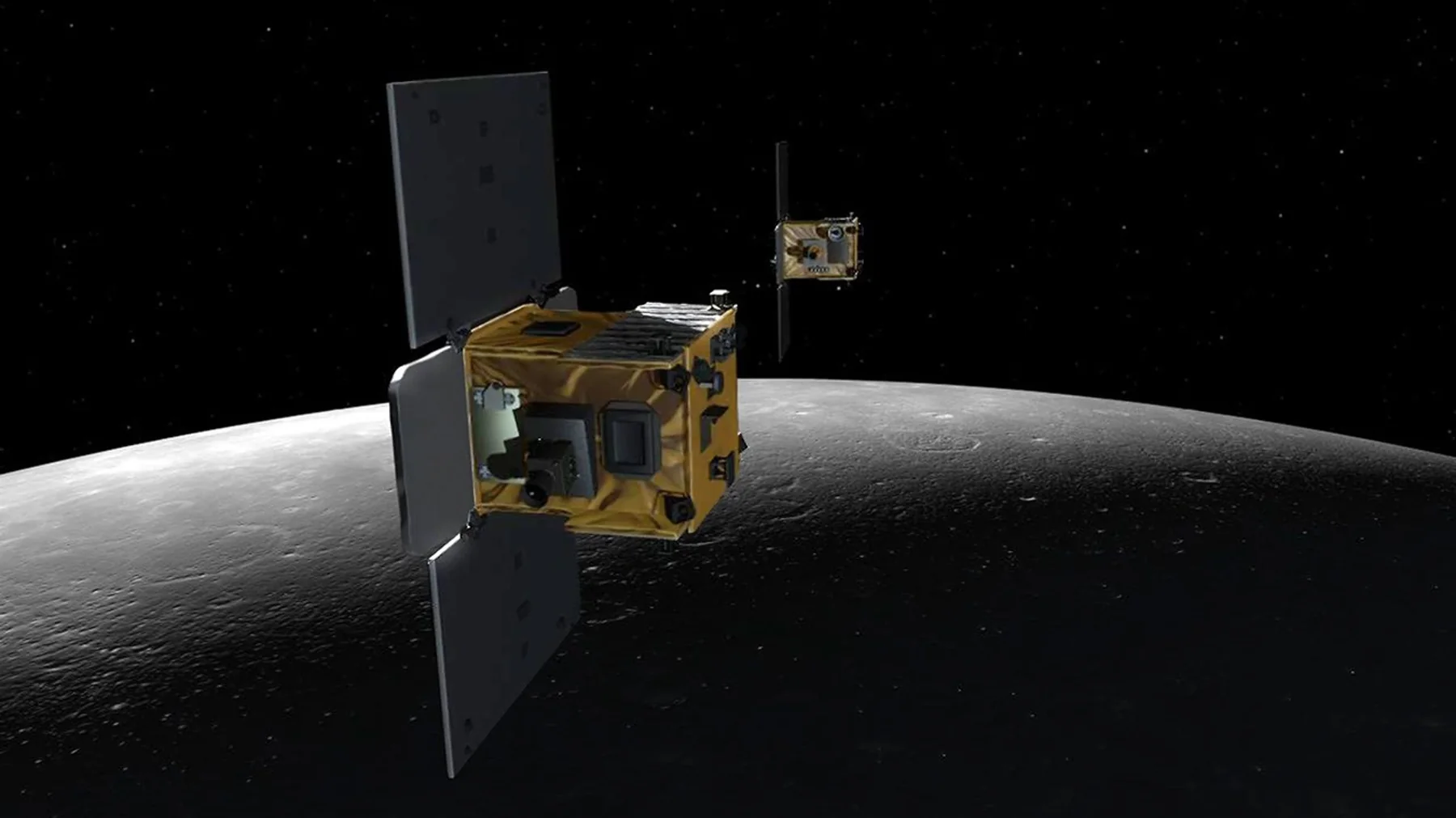
The twin GRAIL spacecraft mapped variations in the Moon's gravity field with exceptional precision.
The mission in three questions
- How thick is the lunar crust and how does it vary?
- What buried structures and mass concentrations are invisible in ordinary imagery?
- How can the Moon's gravity field reveal the consequences of early impacts and magmatic processes?
Mission purpose and context
GRAIL used two nearly identical spacecraft flying in formation to map tiny variations in the Moon's gravitational field. Rather than photographing the surface, the mission measured how hidden mass variations changed the distance between the spacecraft.
Spacecraft and mission architecture
The twin probes, Ebb and Flow, exchanged precise radio signals while orbiting the Moon. Changes in their separation revealed variations in gravitational acceleration caused by crustal thickness, buried structures and mass concentrations.
Payload and measurement highlights
- The Lunar Gravity Ranging System precisely measured changing distance between the two orbiters.
- Radio science connected those ranging measurements to a global gravity-field solution.
- MoonKAM cameras supported education and returned additional lunar imagery.
How this mission collected evidence
| Instrument | Measurement | Scientific connection |
|---|---|---|
| LGRS Lunar Gravity Ranging System | Changes in distance between the twin spacecraft | High-resolution reconstruction of the lunar gravity field and interior |
Browse the lunar mission instrument reference.
Flight and surface operations
The spacecraft entered lunar orbit around the end of 2011 and collected primary and extended-mission data during 2012, flying progressively lower to improve spatial resolution. Both were deliberately impacted at the end of the mission.
Mission sequence
- 10 September 2011: launched the twin GRAIL spacecraft.
- Both entered lunar orbit around the turn of 2011-2012 and were renamed Ebb and Flow.
- During primary and extended missions they flew in formation at progressively lower altitude.
- 17 December 2012: both spacecraft were deliberately impacted at the end of operations.
Science and measurements
GRAIL produced exceptionally detailed gravity maps, constrained average crustal thickness and revealed networks of subsurface structures associated with ancient impacts and magmatic processes. Gravity data also improve understanding of mascons that strongly perturb low lunar orbits.
What changed because of this mission
The mission demonstrated the power of inter-spacecraft ranging for planetary geophysics and transformed models of the Moon's crust and internal evolution.
Mission outcome
The mission revealed details of the lunar crust and interior and produced gravity maps valuable for both science and orbit design.
The outcome should be read against the mission's actual objectives and architecture. Multi-element missions can have different results for an orbiter, lander, rover or sample-return stage, while a shortened mission can still return important science or demonstrate a critical technology.
Continue through the ecosystem
Primary reference
NASA Science - GRAIL. Lunar gravity mapping and interior structure.