
Shackleton Crater
A prominent crater centred very close to the lunar south pole. Its interior includes terrain that remains in permanent shadow while nearby high terrain can receive extended illumination.
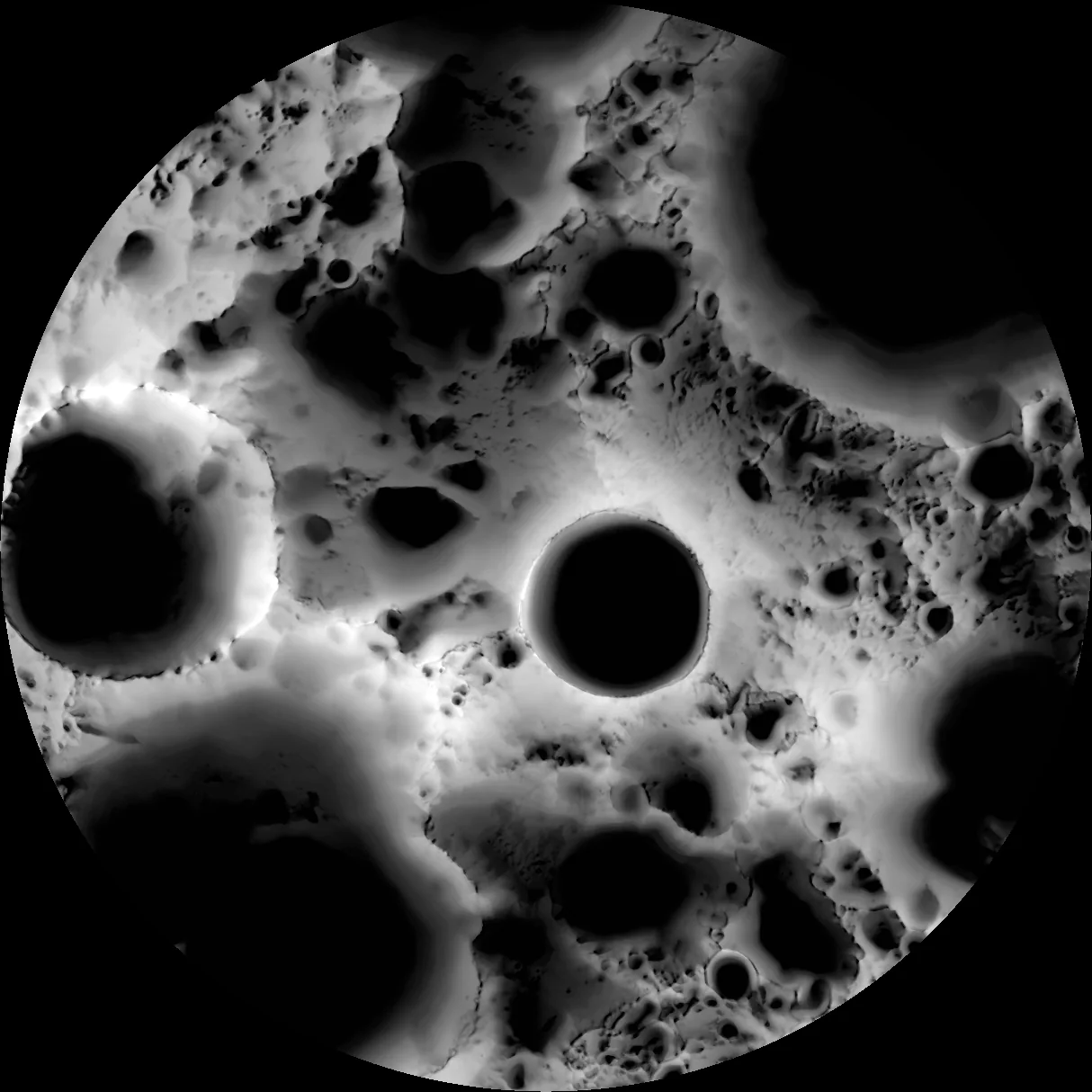
What you are looking at
A roughly 21 km crater whose rim lies almost on the lunar south pole. The interior receives no direct sunlight over normal lunar seasonal geometry, while portions of the rim experience long periods of illumination.
How it formed and changed
Shackleton sits in heavily cratered ancient polar terrain. Its steep walls and permanently shadowed floor create extreme contrasts in illumination and temperature over only a few kilometres.
What scientists learn here
Laser altimetry reveals the shape of the dark interior even where ordinary photography receives almost no light. Radar, thermal and illumination datasets are used together to study surface roughness, cold-trap stability and landing conditions; none of those measurements alone should be treated as a map of extractable ice.
How to find and observe Shackleton Crater
From Earth, Shackleton lies at the extreme southern limb and is strongly foreshortened. It is not a beginner visual target. Orbital imagery and topographic visualisations are much more informative than ordinary backyard views.
Nearby landmarks and exploration context
The lunar south pole lies on Shackleton's rim. Nearby polar craters and ridges form part of the broader terrain being assessed for robotic and crewed exploration.
Why this feature matters
Shackleton is central to polar exploration because illumination, extreme cold and potential volatile cold traps occur within a compact region.