
South Pole-Aitken Basin
An immense ancient impact basin extending from the lunar south polar region across much of the far side.
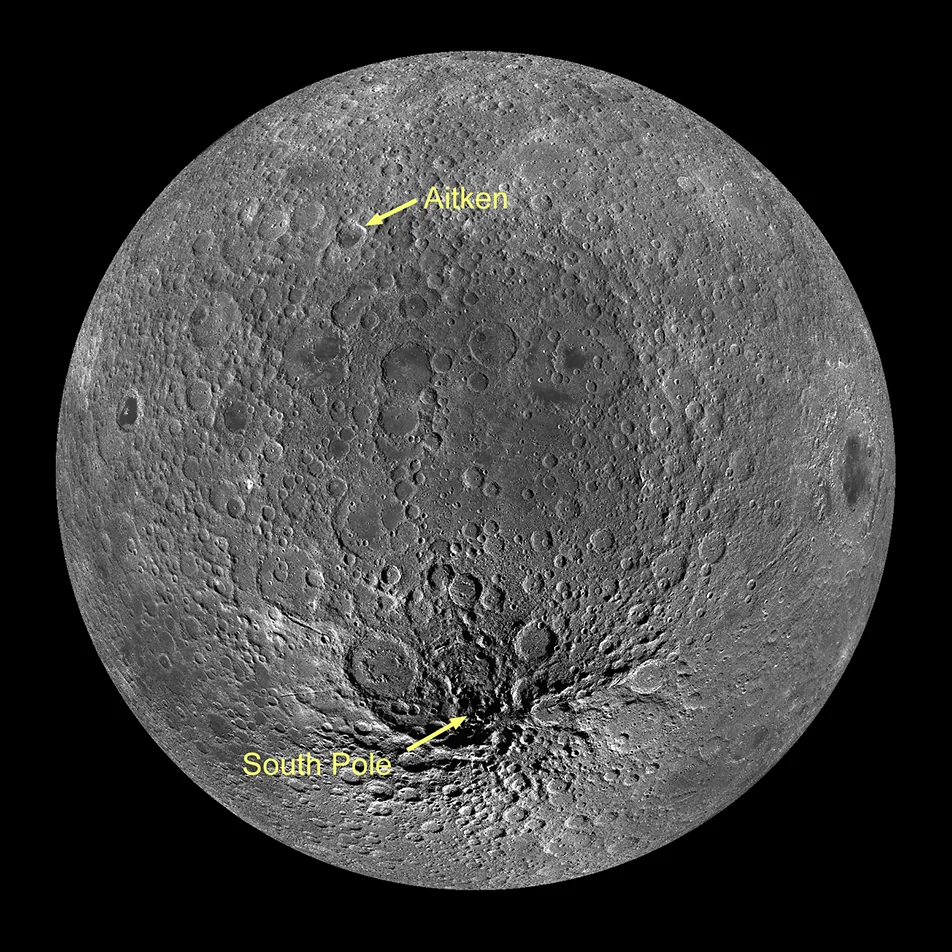
What you are looking at
The South Pole-Aitken Basin is roughly 2,500 km across and is one of the largest and oldest recognised impact structures in the Solar System. Much of it lies on the lunar far side, so its scale is not obvious in ordinary Earth-based views.
How it formed and changed
The impact excavated deeply into the lunar crust and may have exposed material from lower crustal or mantle-related levels. Billions of years of later impacts and volcanism have modified the original basin morphology.
What scientists learn here
Topography, gravity, spectroscopy and samples from material influenced by the basin can test models of lunar differentiation and early bombardment. Chang'e 4's Von Kármán landing site lies within the basin, adding local surface measurements to orbital datasets.
How to find and observe South Pole-Aitken Basin
The basin cannot be viewed as a complete structure from Earth because it is predominantly on the far side. Global spacecraft maps are essential for understanding its full extent.
Nearby landmarks and exploration context
Von Kármán crater and the Chang'e 4 landing region lie within the basin. The lunar south-polar region overlaps its southern extent but should not be treated as synonymous with the entire basin.
Why this feature matters
Its size and depth make it a major target for studies of lunar crust, mantle materials and early Solar System bombardment.